
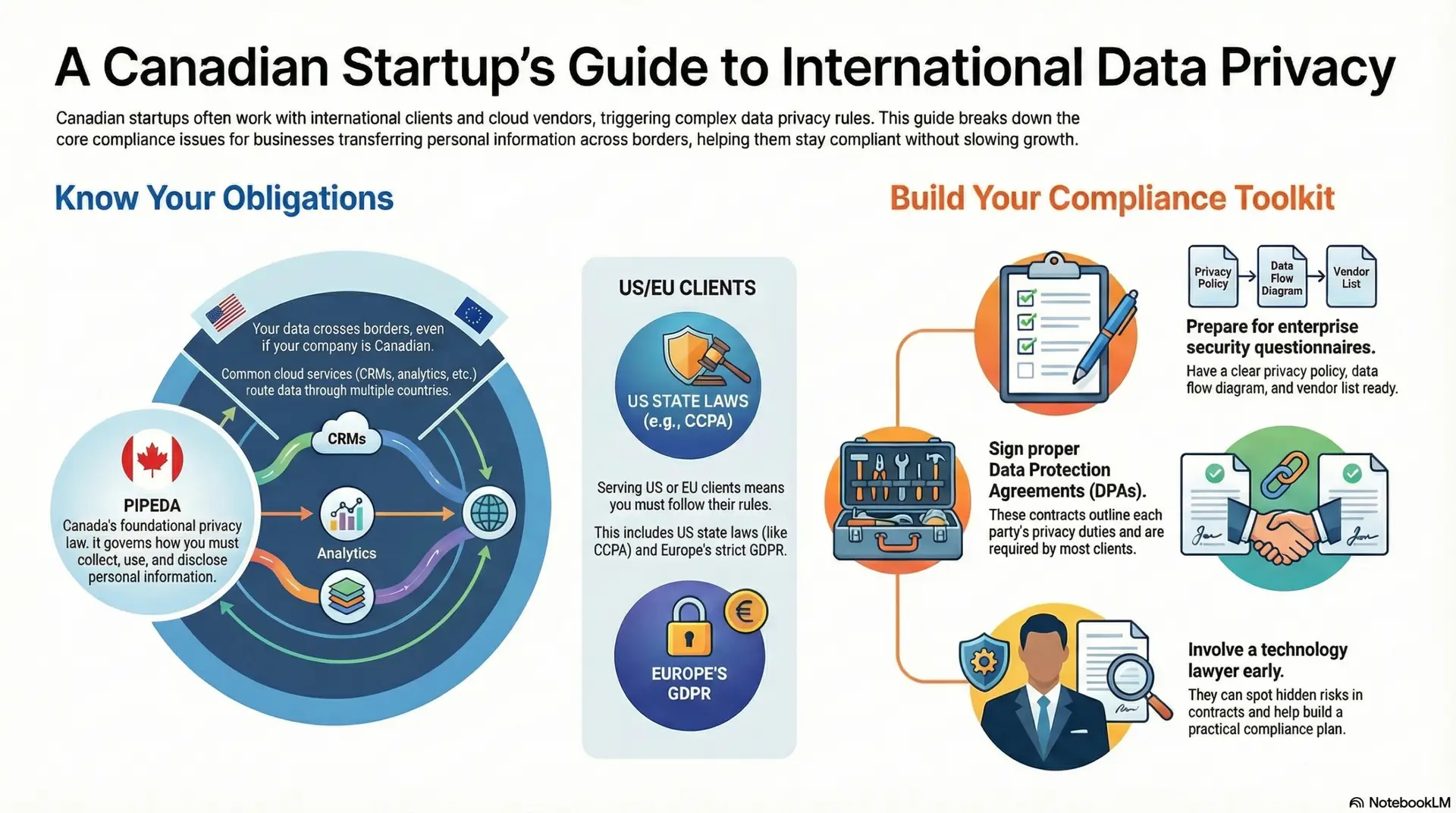
Canadian startups grow quickly, often faster than their internal compliance systems. Many founders focus on product development and customer acquisition. Privacy compliance rarely reaches the top of the list until a client asks for a data protection agreement or an enterprise security questionnaire. By that point, the company is usually scrambling to understand its obligations.
If your business works with clients in the United States or Europe, or relies on international cloud vendors, you are likely transferring personal information across borders. These transfers trigger privacy and security rules that Canadian companies need to understand early. The following guide breaks down the core issues and shows you how to stay compliant without slowing down growth.
1. Understand how PIPEDA applies to your business
PIPEDA is the federal privacy law that governs how private sector organizations in Canada collect, use, and disclose personal information. It applies to most technology businesses unless the business operates entirely within Alberta, British Columbia, or Quebec, which have their own rules. Even then, national or international transactions usually bring the company back under PIPEDA.
PIPEDA requires your company to have a clear purpose for the information you collect, obtain proper consent, store data securely, and limit your use of the information to what is necessary for the service you provide. If you rely on US or international vendors, you must take reasonable steps to ensure that those vendors meet the same privacy protections.
2. Recognize when your data leaves Canada
Many founders assume that their data stays in Canada because the business is Canadian. In reality, most cloud services route data across multiple jurisdictions. Common examples include authentication services, CRM systems, analytics platforms, and payment processors.
You should confirm:
• Where your vendor stores data
• Whether any subcontractors access that data
• Whether the vendor uses offshore servers for backups
• Whether your service logs or machine learning systems transfer data automatically
Cross border data movement is not illegal. You simply need to disclose it and ensure the vendors you rely on meet the same standards you promise to your own customers.
3. Understand how US privacy rules can affect you
The United States does not have a single national privacy framework. Instead, companies must deal with a growing set of state level rules like the CCPA in California and the Virginia Consumer Data Protection Act. If you serve American consumers or collect their personal information, you may need to honour access requests, deletion requests, or opt out procedures.
If you operate purely as a vendor to US businesses, the situation is slightly easier. Your clients still expect you to follow their internal privacy policies and contractually commit to strong data protections. The key is to avoid any contract language that forces your company to comply with rules that do not reasonably apply to your operations.
4. Understand GDPR if you have European clients or users
GDPR contains some of the most rigorous privacy standards in the world. You must follow GDPR if you intentionally market to people in the European Union or if your service reasonably expects EU residents to use it. Even a small number of European users can trigger the rules if your product targets them in any way.
GDPR requires strict consent, impact assessments, data minimization, and a clear lawful basis for each processing activity. It also creates separate rules for processors and controllers. Most Canadian technology companies act as processors when serving their clients. This means your contracts must contain specific GDPR compliant terms.
5. Prepare for enterprise security questionnaires
Large organizations often ask vendors to complete detailed privacy and security assessments. These questionnaires test your internal practices, your vendor relationships, and your incident response plans. You can streamline the process by preparing the following items in advance.
• A clear privacy policy
• A data flow diagram that shows where information travels
• A list of all vendors with access to personal information
• A summary of your security measures and backup practices
• An incident response plan that outlines how you notify clients
Ready answers reduce delays and help you secure larger customers who require strict compliance.
6. Sign proper data protection agreements
A data protection agreement, sometimes called a DPA, outlines each party’s privacy responsibilities. Most US and European clients will require one before they sign a commercial contract. The DPA should align with PIPEDA and any foreign laws that apply to the client.
You want to confirm the following in every DPA.
• The vendor remains responsible for its subcontractors
• Data stays encrypted in transit and at rest
• The incident notification timeline is reasonable
• The audit rights are limited and predictable
• The vendor only processes data based on your instructions
Poorly drafted DPAs can create inconsistent obligations or force your company to perform tasks that do not fit your operations.
7. Involve a technology lawyer early
A lawyer who understands privacy law can map your data flows, review vendor terms, and help you build a practical compliance plan. Most of the work involves spotting hidden risks in contracts and making sure your commitments match what you can reasonably deliver.
Effective privacy compliance builds trust, supports enterprise sales, and prevents last minute panic when a deal is on the line. It also protects your company from complaints, investigations, and contractual penalties.
Contact Onley Law today to get the help your company needs.
Frequently Asked Questions
Does PIPEDA apply when working with US clients?
Yes. PIPEDA applies to Canadian organizations collecting, using, or disclosing personal information in the course of commercial activities, regardless of where the counterparty is located.
Do I need a data processing agreement with US vendors?
Yes. Data processing agreements are essential when sharing personal information with any third-party processor, especially those in jurisdictions without equivalent privacy protections. Book a complimentary initial call.